
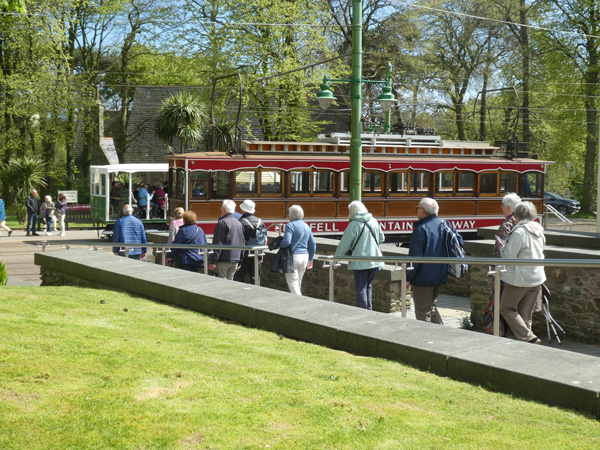
Tickenham WI members Margaret and Rose recently enjoyed a short holiday to the Isle of Man with a larger group from all parts of Avon Federation. They included a number of accompanying husbands. The group was led by Sue, the current Chair of Avon FWI. Other trustees were also present, including Donna, a previous advisor to Tickenham WI, and Judith the Avon representative at our 2026 Spring Lunch.
The following account written by Margaret, with help from Rose, is their account of the trip. The images are courtesy of Margaret.
Besides being windy, the weather was reasonably kind, which helped as the itinerary was full of scheduled visits to many places including four train rides. Unfortunately, only three took place due to a traffic accident. This happened along the tramway in Douglas which meant no horse-drawn tram ride for us. We had the same coach, driver and guide for the whole holiday which was very pleasant.
After being picked up from the airport our first port of call was the Manx Museum in Douglas, capital of the island. The museum houses artifacts showing the natural history, archaeology and social development of the island. The Isle of Man has its’ own coat of arms which includes three legs joined together, two birds (raven and peregrine falcon) and a crown. King Charles III is not known as King of the Isle of Man but Lord of Man.
Our first full day saw us strolling into and around Ramsey before having a ride from Ramsey Station to Laxey along the Manx Electric Railway, which is one of the longest vintage narrow-gauge railways in Britain. At Laxey, some of our party were brave enough to climb ninety-six narrow steps up an external spiral staircase to the top where we were rewarded with some lovely views. The wheel was built in 1854 to pump water from the mineshafts. It is called ‘Lady Isabella’, after the wife of the island’s governor at that time. It was possible to take a short walk into the mine and/or talk to the guide at the entrance. Besides telling us about the mine, the guide told us that we had the best tour guide on the island! After a quick lunch we boarded a train along the Snaefell Mountain Railway to the summit of Snaefell. This route went alongside parts of the road network, including part of the TT race. Afterwards, we returned to our hotel.
The Isle of Man is known for its’ annual TT races which takes place over two weeks in May. The first week is for practice in several different categories with the real races being in the second week. TT stands for Tourist Trophy and the event consists of timed trials along thirty-eight miles of normal roads, including two hundred bends, around the island. The average speed is 130mph with the highest speed being 200+mph, as the quickest time around the track is sixteen minutes. For this event, all roads along the course are closed to ‘normal’ traffic from 8am to 5pm. This means residents along the route must move their vehicles away from the roads. Most residents along the route become bed-and-breakfast guesthouses for the duration of the races.


Our second full day should have started with a ride on the Douglas Horse Tramway but as stated earlier, a car accident prevented that happening. Instead, following a few phone calls, our guide was able to take us to ‘The Royal Chapel’, the Parish Church of St John the Baptist, or Tynwald Church. Our itinerary was scheduled to take us to the Isle of Man parliament, Tynwald, on our last morning. Laws are made there, but are not legal until they have received the Royal Assent which takes place at this church on 5th July every year.
From St Johns, we resumed our itinerary by proceeding to Peel, on the west side of the island. Following a fish-and-chip lunch eaten by the beach and watched over by a raven, we visited the remains of Peel Castle and then the last destination of the day, Peel Cathedral, also known as Cathedral Isle of Man. Peel is one of the world’s smallest cathedral cities with the cathedral consecrated in 1980. Like many modern churches, all the seating has been removed to make it a more adaptable place.
For those people familiar with Rev. Awdry and his Thomas the Tank Engine books, the name of Sodor will be familiar. It’s thought that the inspiration for the books and names came from the Isle of Man.
Our third and final full day took us to the Cregneash Village Folk Museum which provided a working illustration of traditional customs, crafts and skills which Manx crofters undertook. At Church Farm there were some ancient primitive sheep, the Manx Loaghtan (pronounced Lofton) which have horns and lambs which are born black, becoming whiter with age. Apparently, there were some Manx cats but not on view when we were there. In one cottage was a fiddler who told us about the tools used for sewing. Another room contained a harmonium and one of our party was allowed to have a go. The rooms were small and dark with roofs made of a sort of thatch, which is the same as that in the Scottish Highlands.
After lunch in Port Erin, we visited the train museum and then the coach took us to Castletown where we explored Castle Rushen which is one of the best preserved medieval fortresses in England. Robert the Bruce took the castle in 1313 whilst attempting to invade Ireland. We then took the train back to Douglas.
Our final morning saw us at Tynwald, the Isle of Man’s parliament, in Douglas. We were divided into two groups, each with a guide and taken round the whole building. We were told that the parliament consists of two parts:
House of Keys. This has twenty-four elected members, two from each of the twelve constituencies. This is like our House of Commons where bills are discussed.
Legislative Council. This is the Upper Branch of Tynwald. It comprises of eight members elected by the House of Keys and three ex-officio members namely the Bishop of Sodor and Man, His Majesty’s Attorney General for the Isle of Man, and the President of Tynwald. It is like our House of Lords who discuss, challenge and amend bills.
These thirty-five members are the High Court of Tynwald. From here any proposed bills must receive the Royal Assent which is held at St Johns on 5 July every year.
The only available seating, to hear about the workings of Tynwald, was those of elected members. So many of our party became temporary M.H.K. (Members of the House of Keys) and even the Speaker of the Legislative Council.
We then left Tynwald to have lunch at the Ferry Terminal in Douglas before returning to the airport for the short flight home.
We arrived home informed, shattered and tired with weary bones from all the walking. I know some people were counting how many miles they’d walked. Nevertheless, the holiday was memorable, informative and thoroughly enjoyable.